
Source: Emarat Al Youm – Dubai
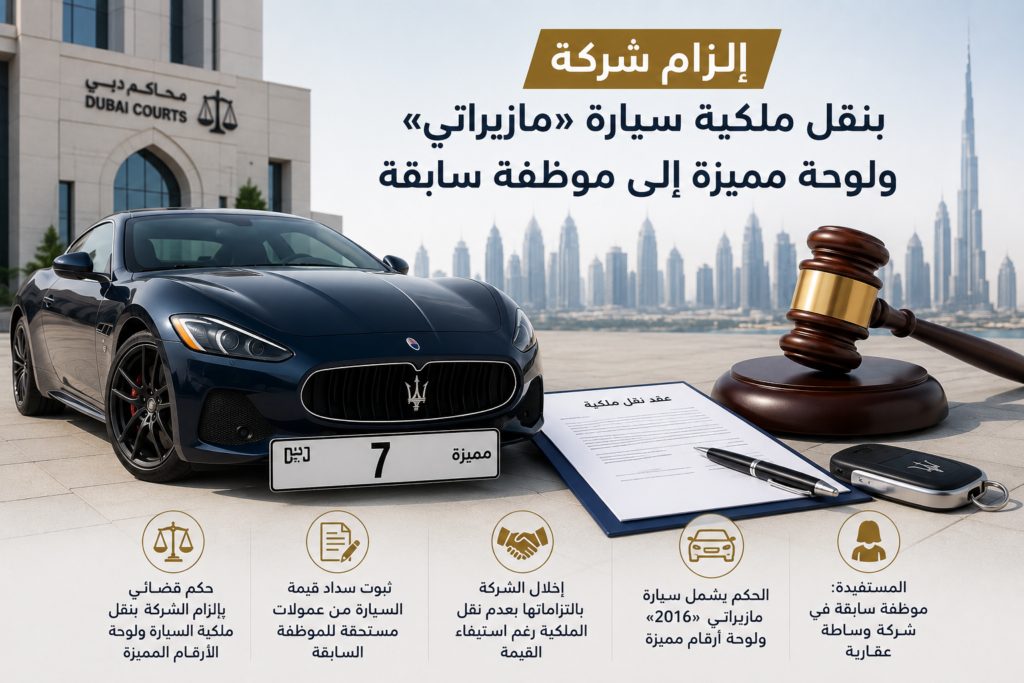
The Dubai Civil Court of First Instance issued a ruling obligating a company manager to transfer ownership of a luxury vehicle and a distinctive license plate to a former employee, after it was proven that she had paid their value from commissions owed to her, while rejecting the remainder of her claims due to insufficient evidence.
The facts of the case can be summarized as follows: the claimant, a former employee at a real estate brokerage firm, sought to establish her ownership of two vehicles and a distinctive license plate. She asserted that she had paid their value from commissions owed to her, based on an agreement with the company manager to register the assets in his name temporarily until she obtained a driving license, after which ownership would be transferred to her.
Following its review of the case, the court appointed a technical expert, whose report concluded that the claimant had indeed paid the value of the first vehicle and the associated license plate. This finding was based on account statements, supporting documents, and exchanged correspondence between the parties, thereby establishing her beneficial ownership despite the registration being in the defendant’s name, Conversely, the report found no proof that she had paid for the second vehicle, due to the absence of sufficient evidence or a clear agreement regarding it.
Based on the foregoing, the court ruled to obligate the defendant to transfer ownership of the first vehicle and the license plate to the claimant and to register them in her name with the competent authorities, while also ordering him to bear the fees, costs, and legal expenses. All other claims were dismissed.
The court emphasized in its reasoning the principle that “the burden of proof lies upon the claimant,” and affirmed the obligation to perform contracts in good faith. It further stated that a breach of contractual obligations entitles the aggrieved party to seek either performance or rescission, in accordance with the provisions of the Civil Transactions Law. The court also stressed that an expert’s report constitutes a valid means of evidence upon which it may rely whenever it is satisfied with its findings.